
Story 2: WHO ARE YOU? Consumer segmentation — Fallacies of Traditional Approach in 4.0 Era

In the last 30 years, the number of Internet users has grown dramatically 271 times from 16 million to 4.3 billion. Human has been undergoing an evolutionary transformation from masters of industrialized value chains into creators of wireless and complex trillions of algorithms. Not to mention, 40% of global population have joined social media including olders aged 65 above and teenagers from 13 years old. Digital has been shaping our contemporary civilization and at the same time diversifying it into a high level of complexity. Multi-perspective identity expressions have made it more difficult for marketers to immerse, segmentize and group people based on geographics, demographics, psychographics and behavioral as they design penetration strategies. In the digital world, we can be anyone. Digital interactions (transactions), logically per structuralist Marxism, require much the amount of social currency we possess and how we leverage it to maintain the objective relationship with other people in a virtual society.
HOW REAL IS THE VIRTUAL WORLD WE ARE LIVING IN?
Einstein’s relativity theories revolutionized how the world should not be perceived fixedly in a certain frame of reference. Our modern capitalist world from a macro level is structured by key following aspects: economic, political, social, industrial or cultural infrastructure. Through the microlens, individuals participate in a socioeconomic landscape using materializable equivalence such as money and status as means of trading. In a virtual space, the new algorithm-based paradigm forms a new equivalence known as social currency. As a consequence, the new socio-scape may evolve according to how consumers engage at each digital touchpoint and their motivations of engagement (trading and partnering).
#Fallacy 1: The virtual images are no more but duplications of real identities
Classical consumer immersion where marketers spend a few days living like invisibles at consumers’ house to observe their daily agenda may not work well in digital context. Personal branding and storytelling skills can now be easily mastered to extend, exaggerate or recreate new identities. Dramas and crimes resulted from digital identity frauds have become common watch-outs for any internet participants. Tracing back to the classic Maslow’s hierarchy of needs, social media may lie on top of the pyramid, falling into belongingness, love, esteem, and self-actualization. In this sense, we should look at consumers the way they want to present themselves in relation to their virtual “trading” purposes instead of jumping into labeling their acts and languages of communication as their traits of personalities and core needs.
In digital, to truly capture authentic identities of consumers, it is sensible to observe screen-based behaviors rather than attempting to collect multiple layers of demographic, psychographic or geographic. We do not recommend opting them out of your segmentation exercise but these data can be confusing in the first place due to information clashes. Amazon’s marketing strategy focuses on behavioral segmentation. Indeed, they divide consumers by their purchase readiness and usage rate, reflecting via their purchasing and browsing history. To identify “risk-averse” vs. “price-conscious” consumers, connection data should be collected including the number of products on wish-list and search frequency on a similar product, time spent per browse on a certain product, etc. Once personas are successfully mapped out, personalized marketing tactics such as customized promotion availability alert or highly targeted brand initiatives will be employed. As long as we can define key metrics that are distinctive according to “trading” purposes, real identities will come to light.
#Fallacy 2: Tribal communities make markets appear bigger than actual demands
Trials and new subscriptions are key marketing targets for new brands. Identifying new groups of consumers and strategizing penetrating plans are also must-have building block in any share-growing marketing plan. Direct to consumer (DTC) activations, once upon a time, were majorly executed offline where there were scaleable polls of audience in certain places to convert. Demand creation, thus, is the combined efforts of product demonstration, on-ground brand education, and instant promotion. Overlapping among touchpoints can be managed at a healthy rate with clear differentiation in lifestage, trial place definition, and activation time planning. However, in digital landscape where players are grouped in tribes of shared interests, overlapping seems harder to be minimized, thus, makes it riskier to quantify potential conversion precisely.
One of the possible alternatives to leverage tribal communities would be assimilation instead of traditional “noise creation-based” penetration. Marketers can possibly shift from “loudly stealing” consumers from competitors to co-living and gradually injecting brand values to current rivals’ tribes by creating a joint “grey zone” like a diligent missionary. As this grey zone definitely grows bigger and bigger, the challenge should be posed as how many grey zones you are in and when they reach the tipping point of “color change”. Once the belief is set, the tangible actions follow. To notice, assimilation process varies across tribes due to differences in defined social currency (tools of communication and trading) similar to how religions take their many forms of articulation in our life. Take a look at Hallyu– the Korean wave initiated from K-pop and now taking its prominence in shaping global culture, presenting itself as a high-value marketing segment as the rise of internet and globalization. To name one international brand that has been successfully penetrating the “Hallyu” tribe: Netflix. By strategically investing in Korean content, Netflix’s ambition is to grow share in South Korea, dominate Asia and qualify a low-cost-but-good-quality-value content creation model which helps to diversify its English-centered content business. A Hollywood thriller-lover and also EXO fan absolutely enjoys whodunnit Netflix original variety show Busted! starring EXO’s Se-hun. Netflix has taken a smart move to assimilate both Hallyu and Hollywood tribes. It is no surprise that the brand has divided their users by 1300 taste communities. On a separate note, scenarios of cannibalization must be calculated carefully as we consider unique cost per subscription and total acquisition payout.
#Fallacy 3: “Content Kings” have been single-handedly ruling digital world
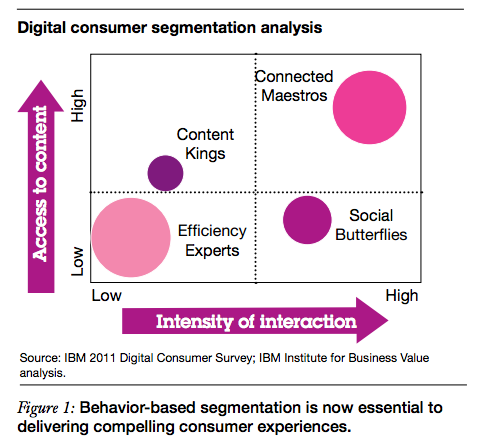
Universal agreement among content and digital experts is possessing king content is the only way to survive. “Beyond Digital” report from IBM issued in 2011 segmented digital players into four categories: Efficiency Experts (41%), Content Kings (9%), Social Butterflies (15%) and Connected Maestros (35%). Despite its smallest salience over digital population, Content Kings shape the majority of virtual information flow without highly active interactions. As their holy name, these royals spark conversation similar to issuing a medieval decree, making peoples voluntarily follow their lead then co-creating based on their initial seeds. From the perspective of Philip Kotler in marketing 4.0, this authority roots from the ability to design an agile marketing ecosystem that allows them to gain more visibility with key consumers via superior influencing power. Continuing successful story of Netflix, one possible explanation for its rapid market dominance comes to numerous deals with reliable local content production companies. 80% efforts have been made to acquire 9% of total audience, but when everything sorts out, 80% results will automatically be delivered with few maintaining activities.
However, success chance can be granted equally across players. Understanding dynamics among all types of players widens your choices of strategies. If you are the new entrant to an established category, your conquest is possibly to find Content Kings (ad-hoc/situational disruptive content providers) and sign strategic treatments on your shared missionary or to spend time becoming one of those. Otherwise, set targets to Efficiency Experts, navigating from the noises and providing convenient solutions based on suggestions from Content Kings and co-creating the new content seeds. Simultaneously, display your engagements with Social Butterflies (community pages) and Connected Maestros (normally top popular A-celebrities). The two groups are in need of community with instant interactions and initial proven models to follow, then scale up. Any evolution is always a “descent with modification”, the passing of good traits from the old to the new.
Interestingly, we may also find that the “Adam Smith” invisible hand behind social engagement is trickily the computer algorithm coded and upgraded through a system of rule-based logics originated by media tech giants and their alliances. The digital information automation process may appear more dangerous as the infrastructure build-up has little involvement of government’s law system. In fact, what people seek, read, interact with everyday is now becoming the new foods for the digital machines they are nurturing. In return, the machines reproduce content and transactions that may trap digital users in their own addictions forever. In other words, humans are molding our own virtual world unconsciously. The cycle will not be broken if there are no variations. Applying this thinking to brand penetration, marketers should ensure a certain amount of brand’s foods (consistent message) and feeding patterns (media frequency) to activate the brand’s X factors while maintaining sufficient proportion of regular content meals. From a product design standpoint, reversely assuming, if Netflix continues its same old patterns of movies personalization recommendations just based on individual user behaviors, there are chances the brand loses their strategic broader point of view on total market demands and future trend predictions. Finding the match point that balances all equations is always the most difficult exercise for any strategist.
LEAN WHO-SEGMENTATION FRAMEWORK FROM BRAND ARTIST
Apparently, the traditional segmentation model did not take into account the complexity of digital identity variations, overlapping of tribal communities plus power of invisible forces driven by players and computer algorithms. At its core, the segmenting philosophy will not be different but the paradigm of new society should be appropriately adjusted. It is fast to judge a person based on his/her visible traits. Yet, it takes time to truly understand what they are made of/from and their motivations of trading and partnering, travel through their minds and straight to their hearts, then finally win them over.
As usual, we provide a lean segmentation framework to accelerate your learning and applications per below.
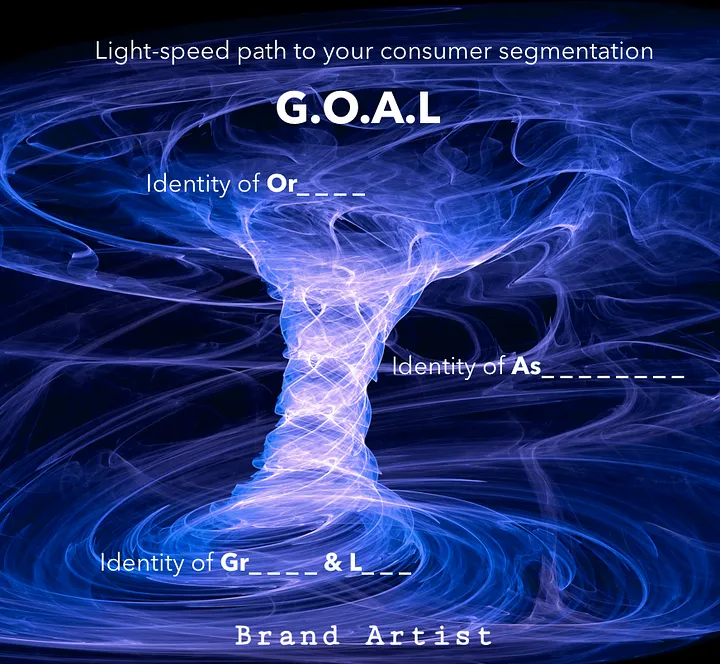
Brand Artist Lean Consumer Segmentation
Hints
1. Identity of Or_ _ _ _ = The way consumers are born and perceive (society input- personal output process)
2. Identity of As_ _ _ _ _ _ _ _ = The way consumers think and dream (plan — imagination match point)
3. Identity of Gr_ _ _ _ & L _ _ _ = The way consumers trade (pain- gain equation)
If you are aiming to win over a potential soulmate, will you dare to pay the highest price?
Next topic: Brand Innovation — Top Winning Secrets of Game Changers
See more: Brand Artist — Series 1: Brand love at 1st sight
Disclaimer: This article belongs to project Brand Artist 101 by Brand Artist Ltd,. The content is designed for only personal learning, reference for free. Any commercial use is not allowed without our approval. Please contact us if you are interested in collaboration. Thank you & happy creation!
Authors: Nguyet Nguyen (Azurie) & Hoang Ha (Sylvie)
References:
- Four new approaches to consumer segmentation in a digital and social age: http://blog.joelrubinson.net/2013/04/four-new-approaches-to-consumer-segmentation-in-a-digital-and-social-age/
- How digital marketing is redefining customer segmentation: https://www.advantexe.com/blog/how-digital-marketing-is-redefining-customer-segmentation
- How to find and engage audiences through tribal marketing: https://minutehack.com/guides/how-to-find-and-engage-audiences-through-tribal-marketing
- https://jyegon.wordpress.com/2015/01/25/hello-world/
- What is K-pop history explained: https://www.vox.com/culture/2018/2/16/16915672/what-is-kpop-history-explained
- Netflix pursues wider Asian audience with Korean content: https://en.yna.co.kr/view/AEN20180425005300315
- Netflix divides its 93 million users around the world not by geography but into 1300 taste communities: https://qz.com/939195/netflix-nflx-divides-its-93-million-users-around-the-world-not-by-geography-but-into-1300-taste-communities/
- IBM identifies four digital personalities to help segment media audiences: https://econsultancy.com/ibm-identifies-four-digital-personalities-to-help-segment-media-audiences/
- Ecosystem marketing the future of competition: http://www.marketingjournal.org/ecosystem-marketing-the-future-of-competition-christian-sarkar-and-philip-kotler/